Introduction
Let’s be honest—off-road riding isn’t just a trend anymore. It’s a full-throttle global movement. The market for off-road motorcycle tires is projected to rocket past $850 million and could reach a staggering $3.5 billion by 2033. For distributors, importers, and buyers, that’s not just encouraging news—it’s a wake-up call.
But here’s the thing: simply stocking popular sizes won’t cut it. Today’s riders know exactly what they want—tires that bite through mud, glide over sand, and cling to rocky climbs, yet don’t disintegrate on the asphalt that connects it all. The real challenge? Striking the elusive balance between fierce traction and long-lasting durability. That delicate trade-off lives not in the tread pattern, but deep within the rubber compound itself.
In this article, I’ll break down the key forces shaping the off-road tire market, unpack the engineering tug-of-war behind grip and durability, and share a few lessons from the factory floor that can help you build a tire portfolio your customers will trust and remember.
1. The Market Is Accelerating — And You Don’t Want to Miss the Ride
The surge in global adventure and off-road riding is creating one of the most exciting opportunities this industry has seen in years.
The numbers speak for themselves. The dirt bike market alone is expected to hit $8.66 billion in 2025, fueled by booming adventure tourism and competitive racing—from motocross circuits to grueling enduro events. Top brands like Michelin and Continental are already investing heavily in innovation, developing advanced tread compounds and eco-friendly materials that balance performance with sustainability.
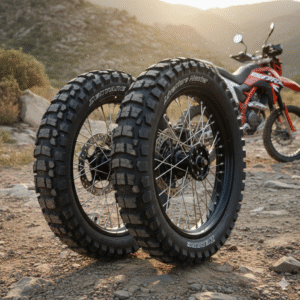
For distributors, this isn’t background noise—it’s the signal. Riders are moving away from generic, all-purpose tires toward purpose-built solutions. Whether it’s a 50/50 dual-sport tire like Dunlop’s Trailmax Mission or a hardcore desert specialist like the Motoz Tractionator Desert H/T, the trend is crystal clear: specific applications win.
To stay competitive, your catalog must reflect this shift. Knowing which segments are growing fastest—and which compounds best serve them—is how you capture market share while others are still catching up.
2. The Engineer’s Dilemma — Grip vs. Durability
Every tire manufacturer knows this balancing act: soft compounds grip better but wear faster; harder compounds last longer but give up traction. It’s a trade-off as old as the industry itself—and the heart of every engineering decision we make.
As Verified Market Research (2024) explains, “softer tires offer superior grip but wear out faster, while harder compounds last longer but provide less traction.” Adventure tires complicate the equation further, as they’re expected to perform on both highways and rugged terrain. As RevZilla puts it, every tire has a “road-to-trail ratio,” and that ratio defines ride comfort, traction, and longevity.
In our own R&D labs, we see this truth play out every day. There’s no “perfect tire”—only the perfect tire for a specific rider. That’s why close collaboration between manufacturers and distributors is essential. A racer’s front tire might demand a tacky, high-grip compound, while a long-distance traveler needs something tougher that won’t fade after a few thousand kilometers. The art lies in knowing which levers to pull—and when—to fine-tune the balance between performance and endurance.
3. Beyond the Tread — The Inside Story That Matters
Here’s a detail that often gets overlooked: what’s inside the tire matters just as much as what’s molded on the outside.
Tubed, tubeless, or mousse—each setup has its champions. Tubeless tires are celebrated for reducing puncture risk, but if the sidewall takes a hit, on-trail repairs can be a nightmare. That’s why many experienced riders still swear by traditional tubed setups—simple, dependable, and easy to fix with basic tools.
Then there’s the rising star: mousse inserts—foam tubes that eliminate flats entirely. Once limited to pro racers, they’re now gaining traction among serious enduro and rally enthusiasts.
For distributors, this means one thing: variety equals value. Your customers fall into different camps. Weekend adventurers may prefer the convenience of tubeless systems, while hardcore competitors demand the bulletproof reliability of mousse or heavy-duty tubes. Offering all three—and understanding the benefits of each—positions you not as a supplier, but as a trusted expert.
The Human Touch — A Lesson from the Mixing Mill
I’ll never forget one of our earliest challenges with a distributor whose riders battled rocky terrain that chewed through tires like sandpaper. They loved the grip of our softer compound, but the tread life just wasn’t holding up.
We could’ve taken the easy route and sold them a harder tire. Instead, we got to work. Our team developed a custom intermediate compound, engineered specifically for their terrain. But that wasn’t all—we tackled their other pain point: frequent pinch flats from low-pressure setups.
Our solution was twofold. First, we paired the new compound with our thick-walled, 100% butyl inner tubes for better puncture resistance. Second, we introduced mousse inserts for riders who needed absolute flat-proof performance. The result? A tailored solution that kept their customers’ trust and built ours.
That experience reinforced a truth I’ve carried ever since: the best products are born from listening and collaboration, not guesswork. Real solutions come from understanding the rider, the terrain, and the expectations behind every purchase order.
Conclusion
The off-road tire market is bursting with opportunity—but also complexity. Success today isn’t about filling warehouse shelves with the right sizes. It’s about understanding the engineering trade-offs, the shift toward specialization, and the complete ecosystem inside every tire—from compound to air system.
Here’s the truth: the best off-road tire isn’t sitting on a shelf. It’s the one designed through expertise, feedback, and partnership.
As you expand your catalog or guide your customers, don’t just focus on the tread pattern. Look deeper—into the chemistry, the compound, and the construction that defines real performance.
Ready to take your product lineup from standard to standout?
Connect with our specialists today to discuss your market’s unique terrain demands and access our latest B2B product catalog. Let’s engineer the tires that keep your customers ahead—mile after mile.